
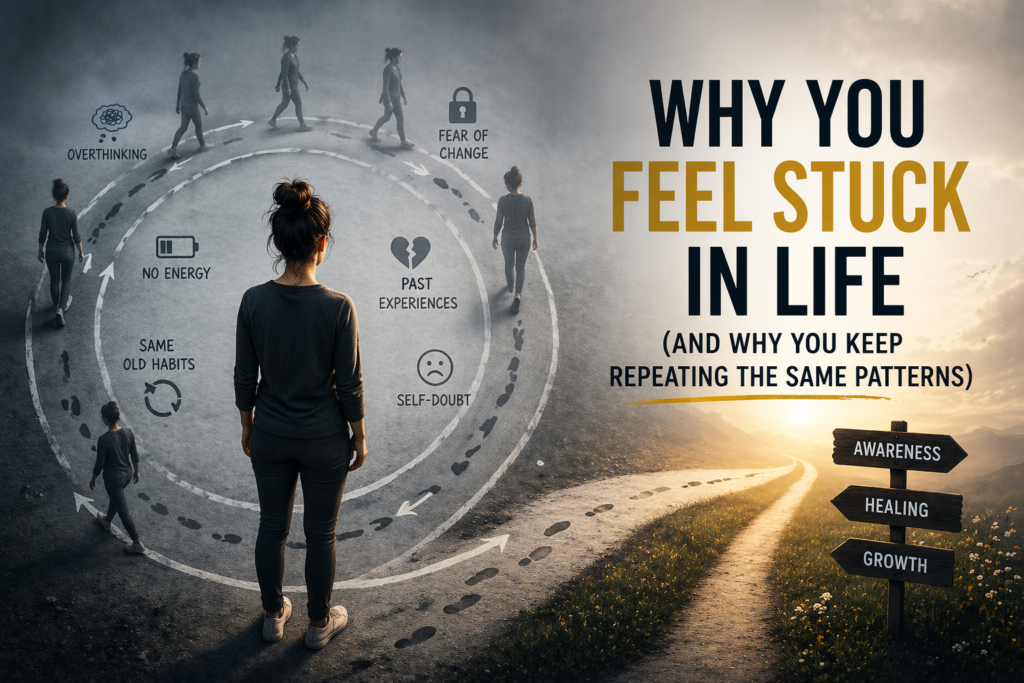
What keeps you stuck is not always what you think it is.
There is something quietly frustrating about being aware of what is not working in your life, and still finding yourself unable to change it.
You can see the pattern clearly.
You know which habits are draining you, which situations are holding you back, and which cycles you have already outgrown.
You have thought about changing it more than once, and part of you genuinely wants to move forward.
Yet when the moment comes to act in a clear and decisive way, something within you hesitates.
This is the point where most people start questioning themselves.
They assume it must be a lack of discipline, consistency, or motivation. From the outside, it often looks that way as well.
But when you look more closely, the reality is more complex than simply not trying hard enough.
Why Change Feels Difficult Even When You Are Ready?
The difficulty is not always in knowing what to do.
In many cases, people already know exactly what needs to change.
The real challenge begins when they start to move away from what is familiar.
Over time, every repeated habit, behavior, or emotional pattern becomes something your mind learns to organize itself around.
Even if it is unhealthy, it still provides a kind of structure.
It gives your thoughts, reactions, and identity something predictable to operate within.
When you try to step out of that pattern, you are not only leaving behind the discomfort.
You are also stepping out of a structure your mind has adapted to.
This is where a subtle but powerful question begins to surface, often without being consciously recognized:
If I let this go, what replaces it?
The Hidden Fear Behind Staying Stuck
This question is not as simple as it sounds.
It does not come from a place of curiosity, but from a deeper sense of uncertainty.
Because what follows change is rarely immediate clarity.
It is often a period where things feel undefined.
The old pattern is no longer fully present, but the new one has not yet taken shape.
In that space, your usual way of thinking, reacting, and making sense of things no longer feels stable.
Most people assume they are attached to the situation itself, but in reality, they are attached to the predictability it provides.
The mind does not necessarily prefer what is better. It tends to prefer what is already known.
This is why people often choose a familiar discomfort over an unfamiliar possibility.
The discomfort may not feel good, but it feels manageable. It is something the mind already knows how to navigate.
Why You Keep Repeating the Same Patterns?
Once you understand this, it becomes easier to see why the same patterns tend to repeat.
It is not simply a matter of willpower or intention.
You can decide to change, set goals, or create new habits, but if the underlying fear of uncertainty is still active, there will always be a pull back toward what feels familiar.
This is where many people begin to feel frustrated with themselves.
They wonder why they continue doing what they already know is not serving them.
It creates a sense of internal conflict, where awareness and action do not seem to align.
But this is not a failure of understanding.
It is a reflection of how deeply the pattern has been learned.
Patterns like this are not created through logic alone, and they do not dissolve through logic either.
They are formed through repeated emotional and psychological experiences, which means they need to be worked through at that level.
The Phase of Change Most People Avoid
There is a part of the change process that is rarely spoken about, but it is the most important one.
It is the phase where the old is no longer fully there, and the new has not yet become stable.
In this phase, there is no clear sense of direction.
There is no immediate reward or reassurance.
There is only a sense of being in between.
Most people instinctively avoid this space because it feels uncertain and uncomfortable in a way that is difficult to explain.
It is not the same as the discomfort they are used to. It is less defined, and therefore harder to control.
So they return to what they already know.
Not because they want to stay stuck, but because it feels more stable than remaining in that undefined space.
Why Surface Level Self-Improvement Does Not Last?
This also explains why many self-improvement efforts do not lead to lasting change.
It is possible to learn new strategies, build routines, and set clear intentions.
These things can help, but they often remain at the surface level.
If the deeper relationship with uncertainty is not addressed, the mind will continue to gravitate back to what feels familiar.
The change may work temporarily, but it does not sustain itself.
This is why it can feel like you are starting over again and again, even when you have already made progress.
How Real Change Actually Happens?
Real change is not only about letting go of what is not working.
It is about developing the ability to stay present in that uncertain phase without immediately retreating back to old patterns.
This requires a different kind of work.
It is less about forcing yourself to act differently, and more about understanding how your internal patterns operate and learning how to remain steady as they begin to shift.
Over time, as you stay with that process, something new begins to take shape.
A different way of thinking, responding, and relating to your experiences gradually becomes more stable.
But this only happens if you allow yourself to move through that in-between phase instead of avoiding it.
Final Thought
If you find yourself going through the same cycle again and again, feeling ready for change but somehow ending up in the same place, it may not be a question of effort or intention.
It may simply be that you have not yet learned how to navigate that part of the process where real change actually happens.
If you are tired of repeating the same patterns or staying in a life that does not feel aligned, you can book a 1:1 coaching session with me to work through these deeper patterns so that change begins to feel steady, natural, and sustainable rather than something you keep trying to force.